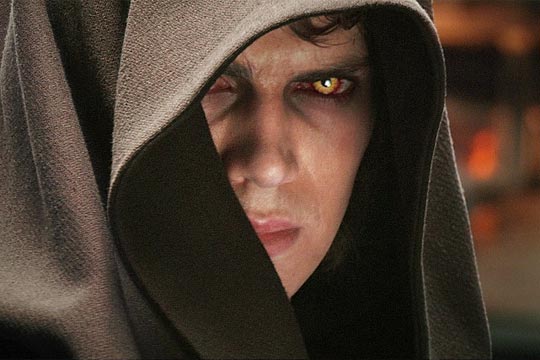
Couple of articles about Lord Voldemort, the villain in the Harry Potter franchise, have come out in time for the movie. I've not read the books or seen thelast movie, so I have no comments of my own, but here are two different perspectives: first from Damon Lindelof, co-creator of LOST:
Darth Vader is possibly the only villain with a presence so big that he's been the subject of six blockbuster movies.
Lord Vader has royalty written all over him. The samurai helmet, the breath mask, the opaque black lenses, the cape, all in black: it's immediately obvious that this is a villain. His unnaturally regular breathing is the loudest thing about him. When he speaks, James Earl Jones' calm baritone gives this character an authority that is second to none on the silver screen. Vader is composed, regal, and utterly ruthless.
But his physical presence is not the only reason that Darth Vader has always been the Star Wars franchise's most popular character. The Star Wars saga is actually Darth Vader's story. I'm not just talking about the prequels, either (although I will get to them): the revelation of Darth Vader's past and the continuance of his character arc to its end is the engine upon which Star Wars is built.
Star Wars is the story of a great warrior who has succumbed to evil finding a measure of redemption.
Luke Skywalker, Vader's heir and the hero of the original trilogy, plots a similar course, but his arc is far less dramatic. In the end, Luke's story serves mainly to explain what happened to his father, and to provoke the final act of Vader's life.
Within the original films, Vader occupies a curious place. In the first Star Wars movie it's unclear what his place is within the Empire. He's obviously an important figure, but he does not have a formal place in the Empire's military. He is referred to as 'Lord Vader', but there is no evidence that the Empire has a feudal hierarchy (although some worlds, such as Alderaan, with its Princess Leia, appear to sport one). Vader's beliefs and his powers are scoffed at by the military officers, many of whom consider him a religious lunatic. When provoked into the infamous vulgar display of power in the board room, he then accepts General Tarkin's order to restrain himself, although it seems clear that he need not. Vader appears to be in charge of important tasks, such as questioning prisoners, and the generals consult with him often, but he is not a military man. He flies a fighter craft in a space battle, but he is not attached to a squadron and seems free to do as he pleases in an actual conflict. We are not shown his master, the Emperor Palpatine, until the following movie, Empire Strikes Back.
Empire Strikes Back is sure the strongest and most popular of the Star Wars movies. This, I think, is because it brings Vader into the foreground, even offering a glimpse beneath the mask. As the title indicates, in this movie Vader is given the initiative by his master and makes a show of how competent he is. His victory is assured despite the rebels' best plans.
The Star Wars prequels reinforce all of this to the point of redundancy. All through the prequels we hear about how Anakin Skywaker is the chosen one, Anakin is the messiah, Anakin is the one who will save the galaxy--but the old Republic doesn't really seem to need saving. In fact, it seems to be in pretty good shape; Anakin's rise in fact leads directly to its destruction.
The Jedi council claims that Anakin will bring 'balance' to the force, and this he does: during the prequels there are but three Sith Lords, but there are scores of Jedi. By the end of the prequels there are two Sith lords (Darths Sidious and Vader) and two Jedi (Obi Wan and Yoda). That's balance.
The origin of the Star Wars films is commonly held to be Akira Kurosawa's movie, The Three Villains of the Hidden Fortress--a title that, I think, is quite telling. The villains are the crucial part of Kurosawa's film, just as they are in the Star Wars saga.
Hidden Fortress belongs to a genre of films known in Japan as Jidaigeki, (note the similarity between 'jidai' and 'Jedi'): period dramas set in the Edo period. While the structures of the films are different, many familiar characters can be found in Hidden Fortress: the spunky princess; a general of great repute, now fallen on hard times; bickering peasants (droids)... and of course a trio of interesting badguys. Most interesting among them is Tadokoro, a former comrade of the general's who has changed sides. Tadokoro has been horribly disfigured as a result of a duel with the general, but in the end he seeks redemption by betraying his new master.
It's a great story, and no surprise that Star Wars grew around it, rather than the 'free-the-princess-stop-the-baddies' premise that it began with.
Star Wars is the story of a villain; make no mistake.
“He’s – I don’t know, I look at him and I think he’s evil. But that isn’t right, exactly, I don’t think he’s evil. I mean, I don’t think he’d ever be cruel or anything like that, for the fun of it…He wouldn’t hurt Pam but he wouldn’t care about her either. If something bad happened to her, he wouldn’t be pleased by it but he wouldn’t try to do anything to help her…” The Green Eagle Score (Stark 1967: 51).
After having read all but one of the Parker series, and I’m simply waiting for that motherfucker (Butcher’s Moon) to finally be re-published, the above may well be the perfect description of Stark’s iconic character.I first came across Parker, renamed Walker and perfectly portrayed by Lee Marvin, in Boorman’s awesome Point Blank (1967). This led to me The Hunter (1962), re-titled Point Blank for a time, the novel on which it was based and then any of the series that I could get my hands on. Amen to public libraries.
I’m not exaggerating when I say I’ve been in up to 25 second hand book shops across Australia and New Zealand looking for any of Stark’s masterly series. All I ever managed to find was The Hunter (in a 2nd hand bookstore in Hawthorn), retitled Payback after Brian Helgeland’s foolish remake (more on that later), and Flashfire (in a 2nd hand bookshop in New Zealand). So thank fucking Christ for University of Chicago Press who a year or two back decided it was time to re-print the series.
I’d met many people who’d heard of Parker and wanted to read Stark’s series but didn’t share my zeal (or is that obsession) with scouring second book stores. I’m now pleased to say I’ve at least a few friends who have purchased books in the series and can discuss what they make of Stark’s structure (seemingly the same, and yet the novels are always so different), Parker himself and the whole attitude of the novels. So what is Parker? Villain or anti-hero? I tend to the latter in as much he’s a cold professional who doesn’t give a shit about anything but the job, rather than a sadistic or tragic murderer. The rare times he has to be ‘civil’ or ‘friendly’ – I can’t say I ever recall Stark giving him a scene where he had to be ‘charming’ – are done through gritted teeth and simply elevate the respect I have for his disdain for all the bullshit that operates on the surface of ‘polite’ society. Some have even described Parker as the ‘non-hero’ and I’m willing to accept that as well.
So if you haven’t read any of Stark’s Parker series heed Lawrence Block’s comment: “Forget all that crap you’ve been telling yourself about War and Peace and Proust – these are the books you’ll want on that desert island.”
Now briefly to Helgeland’s film version of The Hunter. From memory it aint the travesty it could have been but it does smack of yet another remake of a great film that needn’t have happened. There are some who argue it’s more literal than Boorman’s version and hence a worthy adaptation of the novel. Even it we grant that, there are no actors of Gibson’s generation, or the current younger crop who can match Marvin’s portrayal – and at the end of the day, the books and the films are about the character more than the mechanics of the plot. The film also throws in unnecessary elements such as Gibson's voice over and deviations from the novel that seem mere excuses to throw in gratuitous violence.
If there were just one word to sum up the concept of 'evil', it would likely be Dracula.
In the pantheon of western literature's best and brightest villains, Dracula sits high on some dark Olympus, if not at the apex, then comfortably close. Barely on screen in Bram Stoker's eponymous novel for more than a few chapters, nonetheless it is Dracula who drives the book. It is Dracula who drives the films which bear his name, who drives the action in every appearance.
He's the sort of antagonist that brings out the best in a hero, which may account some for his popularity. He's all of humanity's fears and hates and loathings rolled up into one handy package. He embodies themes as varied as cannibalism, rampant sexuality, the 'other' and the fear of death and the dead, as well as more esoteric concepts (the Faustian bargain, necromancy, plague, taboo animals, etc.).
But is that all there is to it? Just some smelly themes and subconscious symbolism?
No. Dracula is the outsider, always scratching at our door, looking for a way in. The thing at the back of the cave, or waiting in the forest. The omnipresent Night, with teeth. The themes and symbols which trail after him like a cloak are but manifestations of his ultimate identity-that of the Thing That Scares Us.
It's why we go back to him, again and again, much as his victims did. We invite him in, even knowing what he is, foul breath and all. We invite him in with books and films and plays and all variety of entertainments, pitting him against ourselves and our archetypes (Dracula Vs. Sherlock Holmes, Dracula Vs. Billy the Kid, Dracula Vs. Superman, etc.), destroying him again and again, but like the Night, he always returns. We mock him in cartoons and commercials, we make him into comic books and video-games, but the savagery never diminishes, the fear never entirely goes away.
It's the fear that we can't do without. The terror of being hunted. We can't forget it, even with all of evolution at our back, with our science and religion and civilization. Some part of us always remembers the cave, and thing that we saw there, waiting to pounce out of the darkness.
We can't get rid of him, just like we can't rid ourselves of the atavistic fears handed down by our primordial ancestors. No matter how much we try to dislodge him, to remake him or remold him, Dracula clings to us, he is in the back of our head. In our blood.
*Edited to add-if you're interested in seeing more about my thoughts on Dracula check out DRACULA MONTH on my blog*
So you got two thugs, Momo and Ernest, sitting in a car, discussing matters of love and the dick. Seen it before? Could be a Tarantino flick or the latest Guy Ritchie work, nah, you got classic Francois Truffaut circa 1960. The film is Tirez sur le Pianiste, aka Shoot the Pianist. A slice of American pulp noir from author David Goodis, adapted into a lowlife Parisian setting by New Wave French director Truffaut.
Differentiated only by a bowler hat and a slouch Kangol style, the two smoking pipe men chase down their prey, brother of main character, Edward Saroyan. Thing is these two guys are fuck ups. They can’t even catch a fat thief when they’re in a car, and he’s on foot. They can’t catch him in a crowded restaurant, and later they can’t catch anyone, until one says to the other show him we mean business. Then they show their guns. Classic thugs, and a classic film scenario, only done French new wave.
Whilst in a car hurtling towards certain doom for a kidnapped Sagoyas and his newly found love, the pair decide to talk about women (See above). The story could use only one person to convey their points of view on life, women they all want it, they ain’t no good cept for one thing, but they compliment each others point of view. With two hostages and all this nasty talk, the hostages might override the degrading point of view, here it becomes a democracy. The thugs even manage to sway their captures into agreeing with them on some points. Power in numbers.
Then there’s the lying. Yeah, they lie. Later on in the film when they kidnap the youngest of the brothers they start boasting about their goods, one wears this and the other that. He boasts about how he wears an apparent Japanese scarf woven so fine that it is made out of metal, but feels like material. The brother disbelieves him. Nope! Swear it is metal or shall my mother drop dead. Truffuat shows the mother dropping dead on the spot.
Finally the shoot out. They shoot everyone, but the people that they’re aiming for.
When a lonely middle-aged film producer, Shigeharu Aoyama, decides to audition potential wives under the guise of casting a new movie, he gets more than he bargained for in Takashi Miike's ground-breaking horror flick, AUDITION.
Before the auditions are held, Aoyama picks out the resume of Asami Yamazaki as his favourite. Of all the demure young girls smiling prettily for the camera, Asami is the one he likes best. Aoyama's confederate warns him that there is something not right about the girl, but after the auditions are held he maintains that she is the one for him. And he seems to be right.
Romance blooms between Aoyama and Asami, but the girl has a dark past and when she finds out that the Aoyama's auditions were a pretext to meet girls she not only takes it badly, she decides to wreak bloody vengeance upon him.
It's not the setup of this classic horror story that is remarkable, it's the execution at the hands of Miike and the actress Eihi Shiina. Miike discards most of the techniques of the slasher genre: there are no jumpcuts, no mysterious shadows, no claustrophobic tracking shots. Miike's camera (in this film) is very still, every shot is lovingly-lit and in-focus. He builds a terrifying atmosphere out of all of that stillness, silence and light. (Textbook example is the burlap sack in Asami's apartment. The sack lies in the foreground by the telephone for a long interval while nothing occurs. Then the phone rings and the sack lurches and screams--there's a man in it. Neither Asami nor Miike's camera react.)
The film is also remarkable for its sudden divergence into David Lynch-style surrealism. Once we understand a little about Asami's dark past the film cuts into a sequence of flashbacks and do-overs in which her past is revised in different ways, as is her relationship with Shigeharu. Is it a dream sequence? Who is the dreamer? There are any number of compelling reasons that Asami could have become what she did. She is somehow able to insinuate her story into the lives of her victims; actually winding her different versions of her own backstory into theirs; rewriting scenes that we have already seen, but always leading to the same conclusion. There is no escaping Asami Yamazaki.
J-Horror is not unique in popular culture say that it relishes the destruction of young girls. This is a staple of fiction in many other genres:suspense, thrillers, crime, mystery and even superhero narratives are filled to overflowing with abused girls, and AUDITION plays right into that. The varying levels of abuse Asami may or may not have suffered in the past have caused her to become this monster, but this film presents those scenarios with the same clear-eyed impassivity that it does every other sequence, rather than fetishizing it in the way of 'torture porn'. AUDITION is far more interested in the vengeance that Asami wreaks upon her (mostly male) victims than in what was done to her. With her ambiguous backstory, Asami can in many ways be seen to represent the vengeful spirit of all of those girls degraded and butchered in decades worth of cheap movies. Aoyama, the protagonist, is presented as pathetic and helpless in this film in a way that Asami never is.
That said, Miike denies that his films have 'messages' and I think it's important to take that into consideration: he is not necessarily criticizing those other movies.
But if all that isn't enough to convince you that Asami Yamazaki is a great villain, the final scene certainly will. Watching her chanting as she works on Aoyama with the wire saw is perhaps the squirmiest scene committed to celluloid. If you haven't seen the film, see it. If you have, I have only one thing left to say to you:
A: When I was first invited to this blog, I immediately thought of SCORPIUS, from Farscape, a TV Show that aired in the US on the SciFi (now SyFy) channel.Though only introduced at the end of the show’s 1st season, he quickly came to dominate that show and tv movie that wrapped up the series.
Q: HOW DID YOU GO ABOUT SELECTING HIM?
A: I wanted to use my first selection to focus on a Villain who is obviously a Villain, a Melodramatic, or operatic Villain.And, I believe that Scorpius is a Post Modern take on just that type of villain.From the Suit, which is all black, to his monstrous visage, everything about Scorpius screams “I’m the bad guy.”
My hope is that this obvious quality will allow me to more easily extrapolate the general truths of villainy that Scorpius points to.
Q: WHO IS SCORPIUS AND HOW DOES HE FIT INTO THE FARSCAPE UNIVERSE?
A: Farscape is a show about an astronaut named John Crichton who, like Dorothy in Oz, is shot across the universe, via a wormhole in space.
The part of the universe John, the hero, finds himself in is ruled by a fascist state of humanoids, called ironically enough, “The Peacekeepers.”Scorpius, when we first meet him, runs a black ops / science program, so he’s in a position of great power.His mission is to create a new weapon for defeating the Scarrans, the chief rivals to the Peacekeepers in this part of the universe.The weapon he believes will tilt the balance of power between Peacekeeper and Scarren harnesses, of all things, wormholes. And though his first meeting with John is accidental, Scorpius’ sole focus after their encounter is to get John.
Scorpius is a half breed, with his mother being of the humanoid variety that inhabit this aspect of space (they call themselves Sabaceans.)His father is Scarren, a reptilian / humanoid blend, who rapes her.Being a half-breed means he’s rejected by both the Scarren and Peacekeeper ethos, as both sides value species purity.If that seems to contradict his being in a position of power, the show exploits this contradiction to show Scorpius’ talent for strategy, manipulation and ingenuity.
Q: WHAT KIND OF VILLAIN IS SCORPIUS?
A: The beauty of Scorpius as a villain is that he’s not just one type of villain; he doesn’t fit into just one category.Scorpius blends a few categories, and the writers put a few twists on these categories to create something quite new and unique (and as they say in the show, “Unique is always valuable.”)
Category 1: Monster - Just from looking at him, we can see this.From his skull-like face, to his deformed body, monstrous strength, resistance to pain and uncanny ability to know when someone is lying, Scorpius oozes monstrosity.
Category 2: Evil Genius – Though he has super strength, Scorpius doesn’t want to use it, and seems genuinely embarrassed when these monstrous aspects shine through.
Scorpius’ chief asset is his intelligence.Like Lex Luthor or Moriarty, he’s a villain who defeats his opponent with his mind.In Farscape's 2nd season, Scorpius literally tries to use his mind to defeat John by implanting a neural chip containing a clone of himself into John’s head, all to get at the knowledge John has.
Category 3: Cool Suited Villain - It’s kind of a subset of both Monster and Evil Genius, but this puts him in the same category of characters like Dr. Doom, Darth Vader.Like these other villains, the suit signals a great weakness that is overcome by the technology.
Q: WHAT MAKES SCORPIUS A GOOD VILLAIN?
A: In terms of plot, a villain is the force the hero smashes up against and stands between the hero and his goal.And Scorpius definitely fits the bill.He’s John’s equal in every way and in many ways, John’s superior.Plots on the show would often resolve with John gaining some small victory, only for it to be revealed that this victory also forwards Scorpius’ agenda in some way.Yet, this alone wouldn’t make him a great villain.Though it might seem obvious to say, a great villain must do villainous things.And here, Scorpius doesn’t disappoint.On first encountering John, he tortures him to get information.As stated earlier, when the information is hard to get, Scorpius installs a microchip into John’s brain, which contains a copy of Scorpius’ personality.Though revealed in a flashback, the imagery used to depict this implies a kind of rape.
In a literal way, Scorpius is behind John, holding a phallic-like object that he jams into John.While that’s monstrous enough, the coup de grace is the ‘neural clone’ or personality of Scorpius that lives in John’s head.Scorpius isn’t just inside John’s body, he’s in his head, his thoughts, and it’s a monstrous invasion.When Scorpius finally retrieves the chip, which has the information he requires, Scorpius leaves John alive, tied to a hospital chair, unable to talk.Since Scorpius is motivated by a desire for revenge, he leaves John in what he thinks would be the ultimate torment, in an impotent life of unfulfilled revenge.
As Scorpius prepares to leave the hospital, he sucks the brain matter that has clung to the chip, off, eating it like a delicacy.The suggestion of cannibalism is clear and these actions solidify Scorpius’ bona fides as a monstrous villain.
Another quality that makes Scorpius a good villain is his intelligence.He remains one step ahead of the hero and constantly surprises both him and the audience with his clever plans.In season 4, Scorpius, seemingly out of power, is buried alive in front of John, by a Peacekeeper Commandant, as a means of showing to John that Scorpius is no longer a threat.When Scorpius appears in the following episode, unharmed, he’s asked, “How did you survive?”His answer, “Foresight.And preparation.”
We’re given no further explanation.Though a potential cop out, by this time in the series we’ve seen Scorpius get himself out of trap after trap, using his keen wit and insight, that we accept this explanation without hesitation.This line also shows another aspect of his intelligence that makes him a great villain: Scorpius is great at turning a phrase.Lines like this seduce the viewer into, if not liking Scorpius, respecting him.
In terms of character, great villains are mirrors of their heroic counterparts.In terms of plot, this means a good villain will have goal that they pursue and they may also have good and compelling reasons for their actions.This is definitely true in Scorpius’ case.Being a product of rape, and identifying with his Sabacean side, Scorpius’ goal is the destruction of those who created and tormented him and who threaten the rest of their universe.Though he’s a mirror, Scorpius is a dark reflection of John, so he’ll be willing to sacrifice anyone or anything, including his own dignity and safety, all to achieve his goal of taking revenge on the Scarrens.This dogged, Machiavellian dedication also compels the viewer and earns Scorpius admiration.
Like a hero, Scorpius isn’t a victim of his origins and circumstance, but instead actively tries to overcome them.His suit is a perfect example of this.Being half Sabacean means that he’s cold blooded, but being half Scarren means that he also craves the heat.His suit’s purpose, partially designed by Scorpius himself, is to regulate his internal temperature, which if left unchecked, could cause his death.
Scorpius reflects John in more literal ways too.Both are scientists, and both, in this side of the universe, are outsiders.Neither John nor Scorpius have a place in social order they find themselves in, but Scorpius lies, manipulates and ingratiates himself into that society while John tries to create his own, more egalitarian society.Where John is trying to use his knowledge for the benefit of all, Scorpius is trying to use that same knowledge to destroy.
Finally, Scorpius is like many great heroes of mythology, in that he’s a schism figure.These characters bridge two cultures and in their blending, create something greater than their parts.Moses, for example, is both Jew, by birth, and Egyptian, by upbringing.Superman is Man and Kryptonian.Hercules is Man and God.Scorpius is Sabacean and Scarren, but instead of these two cultures working together, in him they are at war.This conflict is externalized in Scorpius, with his Sabacean need for cold and his Scarren love of heat.
Finally, the last thing I’d like to touch upon in terms of what makes Scorpius such a great villain is what I’m calling execution.Unlike a purely literary character, whose execution is solely the product of a writer, Scorpius is created by a team: from costumer designers, make-up artisans, directors to the actor himself.Wayne Pygram, the man underneath the suit, did more than recite lines and was quite often an active contributor.An example of this can be seen in the 2nd season episode, entitled, “Look at the Princess: The Maltese Crichton.”Near the end of the episode, John has Scorpius face down over a vat of acid, which just dissolved a Scarren.John tells Scorpius to stop his hunt and lets Scorpius live.After John has left, the camera lingers on Scorpius, alone.Though not in the script, Wayne decided to dip his gloved hand into the ‘acid’ and flick it off with the twist of his wrist.Of course, it does no damage to him at all, making the viewer revisit Scorpius’ previous encounter with John, and realize that Scorpius was never in any danger at all.The whole previous encounter was re-contextualized to be part of some greater plan by Scorpius, making him seem an even more clever and devious character than he was before.
According to Wayne, this addition inspired the writers to go even further in this direction with the character, giving him plans within plans.From the use of his voice, which would lower to a growl as the Scarren side would dominate or raise in pitch when his Sabacean side did, to his cold piercing blue eyes, which Wayne insisted be without contacts in order that nothing got in the way of seeing some humanity in Scorpius, Wayne infused Scorpius with an inner life and soul that makes him a great and compelling villain.
In conclusion, Scorpius is part Monster, part Mad Sceintist, part Hero, wrapped up in a bad ass suit.He’s smart, deceptive, witty and ruthless.He chases the hero, sometimes even protecting him in order to take revenge on his real enemy, those that created and tormented him, threatening to destroy all other life, the Scarrens.As created by those behind the show, Scorpius becomes a singular figure, an adjective, an idea that, like the neural clone, lives in the viewer’s head, whispering things we’d rather not hear.As it should be, with any great villain, he is smiling, damned.
Batman's nemesis, The Joker, behaves in exactly the same way as the playing card that inspired him: he's a mysterious figure who spreads random havoc by his very appearance. The character has been reimagined many times (seventy years of multi-media continuity being what it is, it's difficult to call it an 'evolution'), but those basics have remained: the grinning lunatic of mysterious providence who causes mayhem for little more than its own sake.
The Joker was originally a pyschopath who would poison victims with a strange toxin that left them dead with a hideous smile on their faces. In the post-Wertham 50s and 60s, he became little more than an annoying a clown whose modus operandi was to set up some kind of ridiculous robbery caper, laugh, get beaten up by Batman and delivered to the police. Locked up in Arkham Asylum, he would then escape and then we're back to square one. Cesar Romero's ultra-camp performance as the Joker in the 1960s BATMAN TV show was difficult to take as any kind of serious threat.
In the hands of a succession of writers, the Joker slowly had his teeth restored, starting with Denny O'Neil and culminating most famously in the Alan Moore/Brian Bolland story THE KILLING JOKE, in which the Joker cripples Barbara Gordon, daughter of the Commissioner and alter-ego of Batgirl; effectively restoring his status as a serious threat in Batman continuity. But even with this auspicious team behind him, the Joker was little changed from his original days. Jack Nicholson's version of the Joker in the 1980s Tim Burton movie is much more in line with this restored vision of the Joker, although he's as much Crazy Old Jack as he is the comicbook icon.
A number of postulated origin stories have been postulated for the Joker; most of which see him disfigured by falling into a vat of chemicals with the unlikely result of dyeing his hair green and his skin white). Many of these origins also show him running around as proto-supervillain "the Red Hood" prior to this accident. None of these different origins have stuck: I think that do pin a definitive origin onto the character would destroy his appeal. The power of the Joker is that you don't know from whence it came... but once it appears, all bets are off.
I believe that the most definite change in the character since the 50s came in the recent screen: the late Heath Ledger's portrayal in Christopher Nolan's 2008 film, THE DARK KNIGHT. This (deeply flawed) film has quickly become one of the most popular of Hollywood's comicbook adaptations, and I believe that this is entirely due to their handling of the Joker.
The Ledger/Nolan Joker raises the stakes in several ways. Ont he surface, they've substituted the chemical-bleached skin and hair for makeup. Smudged, smeared makeup, which fails to conceal the mutilated face beneath. Even the Joker's lips are scarred, and his speech is effected by the way he keeps licking them. This Joker is not a scary clown, he's a disfigured freak, and there is nothing remotely funny about his appearance. His jokes are not funny, either--he admits it with some pride. His jokes are not funny at all. Gone is the prancing, flamboyant Joker we've long since grown accustomed to. Gone the false English accent, the ridiculous props, then novelty weapons. The Ledger/Nolan is frightening and capable. This Joker won't surprise you with an exploding cigar... he will stab you to death with a ballpoint pen.
Ledger's Joker has no desire for material gain, all he wants to do is to spread chaos and madness for no better reason than because he can. He comes with his own conflicting set of origin stories, each of them nastier and more real than any of those postulated in the funnybooks--because this Joker has invented them himself.
Fantomas, the Lord of Terror, the Genius of Evil. Whatever his name, he (or she) is the ultimate archetype of villainy. No crime is too small, no act too depraved for Fantomas to contemplate, to undertake, to accomplish. He made it his mission to destroy the fabric of society for no other reason than that he could.
Put simply, Fantomas is the first super-villain. Born at the dawn of the Twentieth Century, on the eve of the bloodiest conflict the world has ever seen, Fantomas sprang fully formed into a world teetering on the edge of madness. To say that he did his best to push it over said edge is an understatement.
"He is totally ruthless, gives no mercy, and is loyal to none, not even his own children. He is a master of disguise, always appearing under an assumed identity, often that of a person whom he has murdered. Fantômas makes use of bizarre and improbable techniques in his crimes, such as plague-infested rats, giant snakes, and rooms that fill with sand."
Criminals like Professor Moriarty or Fu Manchu dominated the previous century, spinning Byzantine schemes and matching wits opponents of equal determination, if not skill. Fantomas' opponents could only scramble to keep up. His schemes were chaotic things, not the precision instruments of his antecedents, but rather a form of madness only recognizable after the fact.
His crimes were outrageous, daring and avant-garde...plague-infested rats released on an ocean liner, sulphuric acid hidden in the perfume dispensers of a famous Parisian department store, or the stripping of the gilded gold from the roof of the Invalides Dome each evening; a man hung by his feet inside a cathedral bell like a human clapper, raining blood, brains and bone down on the masses below, and forcing a judge to witness his own execution by placing him face-up in a guillotine.
Fantomas was everyone and no-one, everywhere and nowhere. A man, a woman, a devil...a phantom. He wielded an army of street-apaches, spies and saboteurs in a calculated effort to spread fear and terror across Europe and the world. There was no purpose to this, save that it was Fantomas' will that it be done. He was a satanic hurricane, a typhoon of terror, a nightmare without end.
In his wake came a host of imitators and disciples...Satanik, Diabolik, Kriminal, Demoniak, Sadik among others, though none would ever rival the first and most mysterious master of menace...FANTOMAS.
Mad Dog is the most bad-ass of bad-asses in John Woo's unlimited-ammo cops-and-robbers masterpiece HARD BOILED. Given that HARD BOILED has more bad-ass per foot of celluloid than just about any other film ever made, that's really saying something. Even more impressive when you consider that the character of Mad Dog wasn't even in the script.
During shooting of the film, Woo decided that the primary villain Johnny Wong was not a threatening enough presence. Meanwhile,veteran actor/stuntman Philip Kwok's action scenes were impressing the hell out of everyone... and so the grizzled henchman Mad Dog was born. This genesis is, I think, the reason the character has such resonance--because he's so underwritten Kwok doesn't get to speak a lot of lines; the character exists almost entirely in the actor's physical presence. The quiet man in the melodrama; the one actor in the opera who does not sing.
Woo's camera treats Mad Dog as a hero as often as a villain: striding down the gangway tossing his bike helmet; stalking implacably through a hospital with a shotgun in a flower box; Mad Dog is a consummate gun-for-hire. In a film that is people by uncannily skilled gunmen, Mad Dog has all the best moves--again, probably due to Kwok's stuntwork rather than to any planning by the director or his writing team.
Mad Dog is a born baddie, but he does have a code he follows--more one of professionalism than of honour, I think. When his boss Johnny steps over the line, Mad Dog turns on him. For Mad Dog this is not a shot at redemption; it's just the work of a true professional, trying to clean up the mess of a job gone wrong. It costs Mad Dog his life... but by then he's already made his mark.
The most hard boiled character in HARD BOILED is the one who wasn't even in the script.
The most obvious quality that makes Patrick Bateman unusual amongst villains is that he's both the protagonist and the narrator of his own story-- AMERICAN PSYCHO by Bret Easton Ellis. (This article will concentrate on the novel, because Mary Harron's movie adaptation falls extremely close to the original text, but there is a lot of information missing.)
Bateman's story is a complete negation of Joseph Campbell's "Hero's Journey"--this 'hero' does not go anywhere, he does not overcome any obstacles, he does not learn anything. The book ascribes him a motto, found signposted on the places he frequents: THIS IS NOT AN EXIT. There's no way out for Bateman, and likewise, there is no way to escape him.
Bateman, from a distance, is a chiseled uber-yuppie who kills people for fun and pleasure. He's rich, educated, he has a job which affords him power and prestige without requiring him to do a speck of work. But as you zoom closer, a lot more... or, depending on how you think of it, at it, less... becomes apparent. Smash cut to appalling carnage or hideous banality.
Bateman is principally defined by a lack of identity: he is a shell of brand names, advertisinng slogans and business-management cliches built around a fleeting and unstable sense of self; a spoiled, blood-soaked avatar of American consumer culture. Although the book is written in the first person, it's six pages before we first hear an "I". The sudden revelation of the narrator's presence in the scene is startling and confusing. He has been standing there in broad daylight, whispering his version of events in our ear all along.
Bateman has no conscience, no capacity for reflection; just a void that he tries to fill with bloodshed, pornography and recycled opinions. He himself tells us that "There's nothing there"; on the few the only occasions on which he describes his internal state he feels "intangible", "like a ghost."
Bateman suffers from psychotic episodes and hallucinations. His ability to distinguish between fantasy and reality shaky at best: he discusses Ed Gein and Leatherface without even attempting to distinguish of them is real and which fictive. He admits that he is used to thinking of reality as if it was a movie, and his description of events often invokes the language of cinematic editing.
Bateman describes his own deeds in the same cool and graphic tone that he discusses movies, pornography or even pop music, and, in fact, accords them equal importance. On the one single occasion where Bateman finds himself in danger, that present-tense narration narration slips into third person as he loses his id altogether--geography and time seem to bend and loop as his faculties depart. But Patrick is nothing if not resilient: after every episode he manages to claw his way back to the nominal level of sanity required for him to participate in normal society. The revelation of just how little is required is perhaps the book's most disturbing facet.
Bateman's crimes are usually wrought upon victims below his social class, with the exception of Paul Allen-- a business rival he believes to be a threat to him (a laughable thought, given the amount of attention Bateman puts into his actual job). He does occasionally spare those who regard him with affection--out of confusion more than anything.
There is only one person in the book that Bateman likes and admires: Tim Price, who Patrick describes as "The only interesting person I know." Tim, initially, is little different than Bateman and the rest of his shallow, yuppie friends: if anything he is even more arrogant and obnoxious than they are, but basically he is quite interchangeable with any of them. Bateman himself has difficulty telling some of his friends and colleagues apart, and is frequently misidentified for 'Marcus Halberstam'. But there is something different about Price: he disappears from the book for a lengthy period, and he returns from his sojourn (rumoured to be rehab) a changed man, daubed with the ashes of penitence (although Bateman may be the only one who can see this).
Price has become more aware of what is going on in the world and he's disturbed by it: he demonstrates a new awareness that people are not always what they seem and a sense of outrage at the lies and evil perpetrated by his (explicitly American) society. Price has returned to the fold, but he has grown as a person and it seems unlikely that he will stay. Bateman admires this, although he does not properly comprehend it. In the end, Bateman remains unable to see the door beneath the sign:
There's an inherent, primordial viciousness to Professor James Moriarty that many of the names you'll see on this blog lack. Whether that's due to the cold-blooded, reptilian nature of the character himself, or to the circumstances of his creation is up for debate.
Moriarty was created to kill. Both literally, and figuratively. Created by Sir Arthur Conan Doyle in 1893, the good Professor was a literary bullet aimed at the fictional heart of Sherlock Holmes by his creator. There's a sort of sleekness about him, crafted as he was to be the dark mirror of Holmes, an insinuating sort of presence-we know who Moriarty is, because he is the reflection of Holmes. He possesses an implacable intelligence that we, as the reader, only understand as an afterthought. Deus ex Machina in a tailored suit and top-hat.
An evil genius with a criminal strain in his blood, his mental faculties rivalling or, indeed, exceeding those of Holmes and his brother, Mycroft, Moriarty was the emperor of the London underworld-a calculating Caligula, a soulless thing of cogs and gears and ruthless appetites. Where Sherlock Holmes is the World's Greatest Detective, Professor Moriarty is the World's Greatest Criminal. The perfect foil, the perfect executioner for a character that had taken on a life of his own, almost separate from that of his creator.
Too, for a character who lacked even the benefit of an on-stage canonical appearance (true, read The Final Problem...Moriarty only pops up in Holmes' hurried explanation to Watson), Moriarty has had an impact reminiscent of one of those heavenly bodies he supposedly theorized about in The Dynamics of an Asteroid. He's the phantom that haunts Conan Doyle's opera house, trailing his shadow across the life of Sherlock Holmes and causing it to wither, even after his primary purpose had been fulfilled.
After Holmes' miraculous return in The Adventure of the Empty House, he was never the same. Still the Great Detective, but somehow lessened, as if the memory of Moriarty's near-victory had a vampiric effect on Holmes' abilities. There are a number of further stories where the spectre of Moriarty haunts Holmes as he grapples with difficult cases, including His Last Bow, the final story in the official canon. The Professor even managed to worm his way retroactively into The Valley of Fear.
Then, consider the influence Moriarty has had on pop culture-eerily reminiscent of that of his enemy, dogging his footsteps beyond the boundaries of canon even as he trailed him across Europe. He has appeared in countless pastiches, sometimes facing his old foe, other times occupying the limelight alone (John Gardner's Moriarty novels, for instance). He has made appearances in films and various other media. He has locked horns with other malevolent figures, including Fu Manchu and Dracula (both of whom also fought Holmes and neither of whom came as close to destroying the Detective as Moriarty himself). Whatever media Holmes conquers, Moriarty is there, slinking through the back door, inflicting himself on the unsuspecting.
It could be said that Conan Doyle, desperate to kill one egregore, unleashed a second, even more sinister one. Desperate to eradicate the ultimate hero, he crafted the ultimate villain, and one thing that villains are good at is cheating death. Moriarty, created to kill Holmes and then fade away like a bad dream, clung stubbornly to life, thrusting himself into the public consciousness via the very act that was supposed to bring about his destruction. And like Holmes, he has flourished in the aftermath, albeit in a more subtle fashion.
Appropriate for such a shadowy figure, don't you think?
Established in suburbia as only Twin Peaks creator David Lynch could, through the close up screams of a grieving housewife and mother, and a static shot of staircase and swirling fan, Lynch cuts into dead prom queen Laura Palmer’s perfect all American bedroom. Once inside, the first glimpse of BOB is visible as seen in the mothers’ vision. He is the quintessential demon and/or drifter serial killer. Grinning, unshaven, clad in dirty denim, and with long flowing wolflike silver hair, BOB peers through the bars of the dead girls bed. The deep symbolism of this introductory shot, being ‘trapped’ in the mirror and enjoying a voyeuristic view through the bars of the teenager’s bed, became intrinsic and central to what was to be later revealed about BOB.
Psychotic strobe visions, deep red dreams and childhood memories seemed to be the only places that BOB could be found, whilst back on the physical plane his presence was dismissed for lack of real evidence. That was until the appearance of a one armed traveling shoe salesman named MIKE.
Peddling his ‘Circle Brand’ boots to the town, the smiling salesman at first seemed like simply a humorous homage to the villain in the old television serial, The Fugitive. Once again, Lynch used this to lower the audience’s guard, and make MIKE a terrifying gateway to learn more about BOB.
Without his mix of schizophrenic depressing drugs, MIKE sweats out the story that he is an ageless evil spirit who had an golden epiphany, finding the light of God. Unfortunately his former partner and familiar, BOB, did not experience it. MIKE also revealed that he was inhabiting the body of the salesman to find his old killin’ partner from the road, and stop him.
Lynch’s use of a familiar as the supernatural villain is an unique one. Many websites and fan literature describe BOB as a demonic entity possessing the physical murderer of Laura, her secretly abusive father, Leland. Some elements of the show do support this theory, see BOB’s confession in the police station basement. With shadows of classic demonic exorcism evidence, the usual flailing against the restraints, total possession of the host, playful teasing of the ‘exorcists’ that turns to unholy taunting, violence, and knowledge of evil events that it was not witness too, the show does present a case for demonic possession. But overall, Lynch and co present BOB as a familiar, an animal that aids with the tasks of the witch or the unholy. In this case the animal is an owl. However, unlike demonic possession, followers of the Catholic Church believe that a spiritual familiar is capable of overtaking the personality rather than the body of its host. This is supported by Leland’s ability to quite capably function and maintain his well groomed appearance as both a lawyer and pillar within society whilst possessed by BOB, until it takes over his will for short periods of madness.
After forty years of symbiosis, BOB eventually bloodily escapes the confines of Leland when he has had his fill of the man’s life and soul. In Leland’s final moments on earth, the show’s protagonists learn that BOB first appeared to Leland whilst he was staying at his childhood holiday home in the woods. This could be interpreted as either a metaphor, or literal account of, abuse, or simply that the spirit had found a new home. In his last act to decimate the soul of the man, BOB unloads all of the evil events that he has made Leland commit, and repress, into his mind. Again, whether this is a metaphor for the last act of conscience a dying man faces for a lifetime of sins, or a literal act, the evil nature of BOB managed to have one last slice of fun before breaking free and temporarily returning back to his wooded home. Soon, he finds another host with which to start the cycle again…
In the aftermath of the horrific events, as the witnesses to BOB’s ‘appearance’ discuss what has transpired, some find it too unbelievable to stomach. Cynical FBI man Albert Rosenfeld, taking the stance of both science and government, believes that whether he really existed or not that BOB may have just been a physical culmination of the evil within the world? This question is one that Lynch presents to the audience throughout the show. One which he only ambiguously answers.
Lynch attributes the casting of BOB to a ‘happy accident’, that set dresser Frank Silva was simply captured in shot whilst the bedroom was being filmed. Unfortunately, Silva died in 1995 due to AIDS. Besides working as a set designer on many Lynch productions, his only other non-Twin Peaks acting role was in the Anthrax video, Only. An appropriate final rockin’ appearance for the spirit of small town evil.
You can tell that Angel Eyes is the villain the moment he appears on screen in Sergio Leone's classic Spaghetti Western, THE GOOD, THE BAD AND THE UGLY. The black gaucho hat and the moustache are early tells, but in this film all of the three titular characters are criminal. There are a number of clear factors that make Angel Eyes the true villain amongst this motley of gunslinging thieves.
Angel Eyes is a bounty hunter who is working his own angle. When we first meet him, he is questioning a man names Stevens about his ultimate quarry, 'Bill Carson'--a soldier who has absconded with a fortune in gold. Angel Eyes accepts a mission from Stevens to kill his own employer, Baker--and then he kills Stevens, and then Stevens' oldest son. Then he goes and kills Baker, too, collecting payment from both sides. This is not some twisted sense of honour at work; he just doesn't like to leave loose ends. Angel Eyes is thorough.
Angel Eyes works for a living, but he is his own man--and like most good villains, he is the character who seizes the initiative. Blondie (Clint Eastwood, "The Good") and Tuco (Eli Wallach, "The Bad") mostly react to their surroundings. Quick wits, luck and naked greed propel them through the story, but Angel Eyes has a plan. Blondie and Tuco discover the secret of Bill Carson's gold purely by chance; Angel Eyes is the one who goes looking for it. Left to his own devices, Blondie returns to his original petty scam. Tuco works himself into a tizzy wanting the gold, but without any real idea of how he's going to get it once he finds Blondie. Angel Eyes takes the strategic view: he installs himself as an officer at a nearby Union army stockade so that he can monitor who comes and goes through the area.
The chaos of the Civil War is a big part of this movie. For Blondie and Tuco it's just part of the environment that they have to contend with while they engage in their criminal pursuits: a stray cannonball saves Blondie when he is captive in a hotel; a Union patrol mistakes them for Confederates and captures them. Angel Eyes, however, is smarter and more imaginative: he makes the army work for him.
Angel Eyes is the very model of a smart criminal: he knows immediately that he can torture information out of Tuco, but not Blondie--so he forms a partnership with him. Angel Eyes is reasonable. He's long-sighted and expedient; a leader of men who is yet more than capable of doing his own dirtywork.
Lee Van Cleef plays his character with a restraint that's rare in the gallery of fulminating, cackling, cape-swirling villains. In the screenplay, Angel Eyes is named "Sentenza" -which means "Verdict" in Italian - and with good reason. He is patient, calm, and quietly good humoured... but one look in those angel eyes and you can tell that he's judging whether your life or death will bring him greater profit.
Hello there, puny mortals, and welcome to Smiling, Damned.
Here on this blog we are going to analyze the greatest perpetrators of villainy in popular culture and literature.
What makes a good badguy? Which villains do we love to hate, or hate to love? Who has the baddest hat or the ass-kicking-est boots? Why should you turn your collar up and just how much swirl in your big black cape is too much?
We will discuss the characters, their creators and the various artists who have brought them to life in any and every medium.
The big black steam train is coming, so twirl your moustaches and laugh--or you might find that it's you tied to the tracks.